Skip to content
AI Brains Labs

One method. Many products.

AI Brains Labs builds and operates AI products for work that general-purpose assistants handle badly — too specific, too regulated, too consequential. One method, applied domain by domain, with paying clients on the other side.

AI Brains Labs started its developments in May 2026.
In its first quarter it shipped two products, put LawAgent into production with paying clients in Brazil, and earned national press coverage.
Founded 2026
New Jersey, USA

Major projects.

Complex, multi-layered SaaS platforms, built to be run by the professionals who depend on them.

Major project · In production

Sovereign AI for elite law firms.

LawAgent is the operating system for legal work — case organisation, research, drafting and review in one connected flow, running on infrastructure the firm controls. It covers 28 areas of Brazilian law, from litigation to strategic tax advisory.

It started in Brazil for three reasons. The country has more active court cases than any other, by the count of Brazil’s National Council of Justice (CNJ). The legal AI that existed was built elsewhere and does not know how Brazilian practice works. And consumer chatbots give lawyers pasteurised answers they cannot rely on. LawAgent is built from how the work is actually done — a method that travels. The next market is the United States: the same platform, rebuilt for common law.

Market
Brazil today; the United States next, rebuilt for common law
Buyers
Law firms, corporations and consultants
Traction
In production with paying clients in Brazil since May 2026. SaaS, monthly credit packages from R$5k to R$50k; R$2M invested to date (O Globo, 19 August 2026).
Built on
Google Cloud, multi-model AI, private per-firm knowledge graphs
Press
O Globo, Valor Econômico, Terra, Manhattan Connection and others
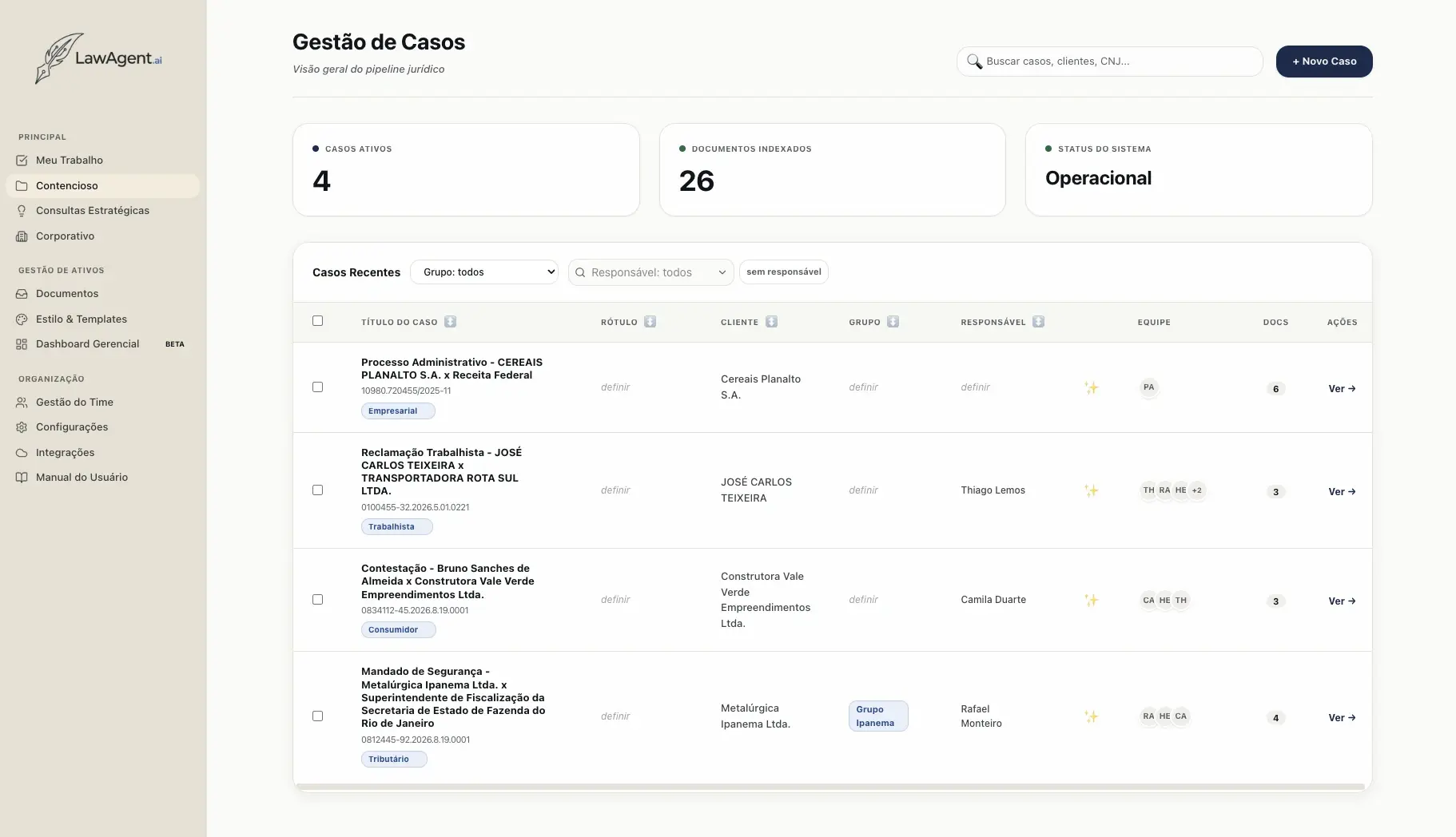
LawAgent’s case-management screen: the firm’s active cases with client, group, owner, team and document counts, plus indexed-document and system-status tiles.

Apps.

Products with faster cycles and a smaller surface, built to answer a personal, short-term question rather than an institutional one.

App · In production

AI that gets you off the screen.

Mora AI designs real-world experiences — trips, days out, evenings — from what you actually want rather than what’s popular. It reads intent and context, then builds the plan.

In development

The next one is being built. Ask me about it on a call.

One method, applied repeatedly.

  1. 01 · The wedge

    Every project starts in the same place: a customer need that one chatbot cannot meet. Work that is too specific, too regulated, or too consequential to hand to a general-purpose assistant. General models get better every quarter — that is the assumption, not the risk. What they don’t close is domain depth and control over the data.

  2. 02 · The harness

    A model is a component, not a product. What surrounds it is the product: layered pipelines that verify their own output, deterministic paths where the answer has to be exact, model-agnostic by design so no single vendor is load-bearing, and an architecture that keeps the client’s data where it belongs.

  3. 03 · The timing

    Until recently, a build like this required a funded engineering team. It no longer does. The constraint moved from engineering capacity to judgment — framing the right question, designing the solution around it, and building the harness that makes it hold under real conditions. That is what twenty years of operating buys.

  4. 04 · The proof

    A product should earn a paying customer before it earns a pitch deck. LawAgent went into production and generated revenue in the company’s first quarter. That is the bar every project here has to clear.

André Estrella, founder of AI Brains Labs

20 years building new functions at Johnson & Johnson, Goodyear, SC Johnson and British American Tobacco — six industries, four countries, three continents · Executive education: Stanford GSB · MIT Sloan · MBA, Instituto de Empresas - IE, Madrid

I’m André Estrella.

For twenty years I built functions that did not exist yet. Six industries, four countries, three continents, and always the same assignment: arrive where there was no process, design it, hire and train the team, and own the number it produced. In almost every case the process only held because I built a system underneath it to carry it through the organization.

Starting one of those builds used to require the same three things: a large team, a multi-year plan, and a budget in the millions. That requirement is why the work lived inside corporations — they were the only ones who could fund it. It doesn’t require that anymore. What once took an engineering department I can now build myself, which moves the scarce part of the job from building to choosing: which problem is worth solving, and what “solved” actually looks like to the person doing the work. That is the part twenty years of owning these areas taught me.

AI Brains Labs is where I apply it on my own account: find work generic tools handle badly, understand it closely, and turn that understanding into software with paying clients on the other side.

Let’s talk.

This call is for investors and potential partners. Twenty minutes, with me directly.

We’ll cover what’s live today, the numbers behind it, and where the next twelve months go. If it’s useful, I’ll send the deck and the product access afterwards.

Questions.

What does AI Brains Labs do?

AI Brains Labs builds and operates AI products for specialized domains — work that is too specific, too regulated, or too consequential for a general-purpose assistant to handle well. The portfolio runs in two tiers: major projects, which are full platforms, and apps, which are smaller mobile products. LawAgent, an AI platform for elite Brazilian law firms, is the current major project. Mora AI is the current app. Others are in development.

Why more than one product at this stage?

Because the reusable asset is the method, not the vertical. How we frame the problem, build the retrieval and verification layers around a model, and keep the system auditable transfers across domains — which makes each product cheaper than the one before it. Effort is not distributed evenly, though: LawAgent has the market, the revenue, and the majority of the attention. The apps tier exists to test ideas cheaply and keep the method sharp, not to split focus.

What happens as general-purpose models get better?

We assume they will, quickly, and the design assumes it too. Our systems are model-agnostic, so a stronger model is an upgrade rather than a threat. What a better general model still does not give a law firm is a deterministic path where the answer has to be exact, an audit trail its partners can defend, jurisdiction-specific depth, and control over where its clients’ data lives. That gap is the business.

Why Brazil first?

Brazil is a large, document-heavy legal market with its own procedural systems, its own courts, and its own Portuguese-language jurisprudence — depth that US-centric legal AI does not cover. It is a market where a well-built local product beats a better-funded generic one. The architecture is not Brazil-specific; the US is the next market.

What is the current traction?

LawAgent is in production with paying clients in Brazil, generating recurring revenue, and has been covered in the Brazilian business press. Several additional firms are in evaluation. The honest read: the product sells, and the current work is converting that pipeline into contracts — early commercial validation, not scale.

Who runs it?

André Estrella founded AI Brains Labs after twenty years in operating roles at Repsol YPF, British American Tobacco, SC Johnson, Goodyear, B2W Digital, and Johnson & Johnson — six industries, four countries, three continents, in local, regional, and global roles. The pattern was consistent: build a function that did not exist yet, own its results, and build the system underneath it.

LawAgent’s sales and distribution in Brazil run through a local partner, and specialists come in where the work requires it — including a local practicing lawyer who partners with us to validate LawAgent’s legal output before release.

How does the company make money?

Software subscriptions. LawAgent is sold as B2B SaaS to Brazilian law firms through a local distribution partner that pays royalties to the US entity, which holds the product, the IP, and the infrastructure. Apps are sold direct.

Where is the company based?

AI Brains Labs LLC is a US company, registered in New Jersey and operating across the US and Brazil. Product, IP, and infrastructure sit with the US entity; LawAgent reaches the Brazilian market through a local distribution partner that pays royalties to it.

Are you raising?

I’m in conversation with investors and partners. The fastest way in is a 20-minute call.